The dealer levels as JSON, for your own code.
One read-only token opens FirmTape's levels to any script: the zero-gamma flip, the call wall, the put wall and net gamma of the volume book, with the open-interest book alongside, for SPX, the futures views and 123 tickers. The same numbers the terminal and the platform plugins draw.
LIVE.
Open the terminalIn the LIVE guide
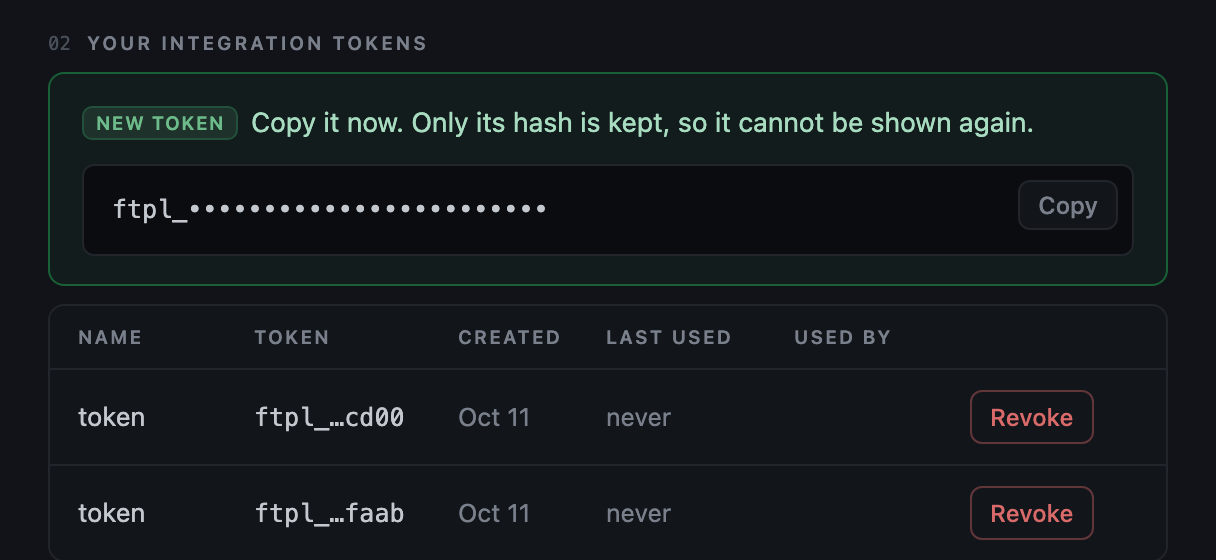
Why: the levels as data, with their book and time, for a bot, a sheet or a dashboard of your own. Where: a token from Account, Integrations; the requests are on the reference page.
How to use it
- Create an integration token under Account, Integrations.
- Send it as a bearer header with each request, as the reference shows.
- Ask for up to twenty symbols at once: SPX, ES, NQ, RTY or any ticker on Symbols.
- Add gamma by strike when you need the ladder, or the day's levels as a series.
How to read it
- Each answer names the book and the time of the reading; a future also names its contract and basis.
- An unchanged reading answers with no body, so polling every few seconds costs little.
What it measures
The volume book's zero-gamma flip, call wall, put wall and net gamma, with the open-interest book alongside. SPX's book is rebuilt every second; a ticker's every five minutes; ES, NQ and RTY are the index books moved by the day's basis.
Limits
120 requests a minute per token. A revoked token or an ended plan stops working within a minute. Every field and error is on the reference page, with an OpenAPI document.
Related
Questions
- What does a request need?
- An integration token from Account, Integrations, sent as a bearer header. A tool that cannot set headers can pass it in the address, as the reference explains.
- How often can I call it?
- 120 requests a minute per token. An unchanged reading answers with no body and does not count against the limit.
- Which symbols are covered?
- SPX, the ES, NQ and RTY views, and every ticker on Symbols, up to twenty in one request.
- Does it carry the measured book?
- No. The API carries the volume and open-interest books; the measured book stays in the terminal.
- Where are the field names and errors?
- On the reference page, /docs/developers/live, with an OpenAPI document a client can generate itself from.